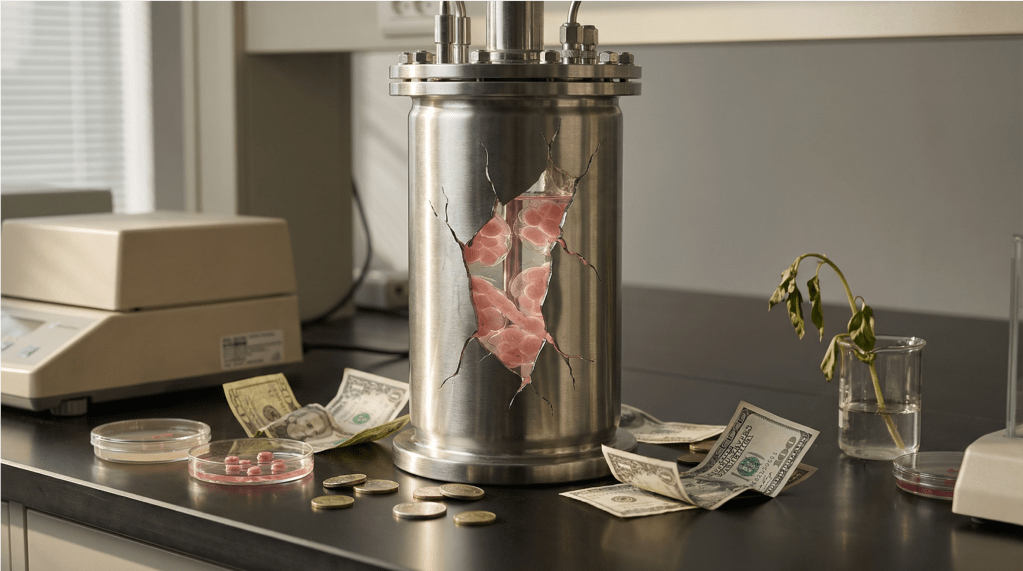
For more than a decade, cultivated meat has occupied a unique place in the imagination of food technologists, investors, and policymakers. It promised a future in which meat could be produced without slaughter, land use could shrink dramatically, and climate impacts could be reduced at scale. Few technologies have carried such moral weight while simultaneously demanding such extreme technical precision.
The bankruptcy of the Dutch cultivated meat startup Meatable in late 2025 marks a sobering moment for the sector. Not because cultivated meat has failed as a concept, but because the industry is finally confronting an uncomfortable truth: this is not a technology for investors seeking fast returns.
From Promise to Reality
Meatable’s trajectory initially looked textbook-perfect. Strong academic roots, proprietary cell technology, an ambitious vision, and substantial venture funding. In April 2024, the company hosted a tasting in Leiden, serving sausages made with cultivated pork fat. It was a symbolic milestone: cultivated meat was no longer a laboratory abstraction but something that could sizzle in a pan.
Yet less than two years later, the company was liquidated after its lead investor, Agronomics, withdrew support. Roughly €85 million had been spent in seven years. The technology had progressed, but not fast enough to justify continued capital injections under venture-style expectations.
For early skeptics, this outcome felt inevitable. Long before Meatable’s founding, critics had pointed to the fundamental mismatch between living cells and industrial economics. In 2017, I outlined three structural technological barriers facing green proteins and cultivated meat: cost of growth media, scaling of bioreactors, and thermodynamic inefficiencies. Those barriers never disappeared; they merely became better hidden during years of abundant capital.
Cultivated Meat Is Not Software
At the heart of the problem lies a misunderstanding of what kind of innovation cultivated meat actually is. This is not a digital platform, nor a consumer app, nor even a typical biotech play.
Cultivated meat sits somewhere between pharmaceutical bioprocessing and commodity food manufacturing — and inherits the disadvantages of both.
Like pharmaceuticals, it requires:
- sterile production environments,
- deep biological understanding,
- long regulatory approval cycles,
- and extensive validation.
Like food, it must ultimately:
- be produced at enormous scale,
- at razor-thin margins,
- with extreme cost sensitivity,
- and broad consumer acceptance.
Unlike pharma, however, cultivated meat does not benefit from monopoly pricing. A hamburger will never command the margins of a life-saving drug. This single economic fact fundamentally reshapes the investment logic.
Investor Time Horizons Matter More Than Technology
Meatable’s failure cannot be explained by technical incompetence. On the contrary, insiders point to a sequence of strategic decisions shaped by investor pressure rather than scientific readiness.
Agronomics, Meatable’s main backer, is a publicly listed biotech investor. That structure imposes expectations: milestones, visible progress, and credible pathways to near-term returns. In cultivated meat, those expectations are almost always misaligned with biological reality.
Living cells do not scale linearly. What works in a lab behaves differently in a 10,000-liter bioreactor. Growth media that perform well at small scale become prohibitively expensive at industrial volumes. Regulatory dossiers expand rather than converge. Each apparent shortcut introduces new questions.
Former leadership reportedly pushed for accelerated market entry, starting with Singapore, then the United States, and eventually Europe. Singapore, often portrayed as a fast-track jurisdiction, turned out to be far more rigorous than anticipated. Each regulatory question required new experiments, new data, and more capital. Eventually, the company ran out of runway just as approval seemed within reach.
This pattern is not unique to Meatable.
The End of the Cultivated Meat Hype Cycle
The broader investment context has shifted dramatically. According to data from The Good Food Institute, global investment in cultivated meat peaked in 2021 at $1.36 billion. By 2025, funding had collapsed to a fraction of that amount.
This was not only about cultivated meat. Sustainable food lost momentum as venture capital pivoted toward AI, defense tech, and energy infrastructure. Many early investors in alternative proteins were, in hindsight, tourists: enthusiastic, well-meaning, but impatient.
As funding dried up, several cultivated meat startups quietly disappeared. Others downsized, merged, or pivoted toward ingredients rather than consumer-facing products. The industry is shrinking — but also maturing.
Why Some Companies May Survive
If cultivated meat were truly impossible, the sector would be collapsing entirely. Instead, what we see is selective survival.
Dutch competitor Mosa Meat, for example, remains operational and recently secured additional funding for scale-up. The difference lies not only in technology but in positioning.
Mosa Meat:
- avoided genetic modification, reducing regulatory friction in Europe,
- focused early on cost reduction rather than rapid market entry,
- built partnerships with established food and feed companies,
- and treated cultivated meat as a long-term industrial transformation, not a startup sprint.
Crucially, its investors include parties with strategic interests in future protein supply chains, not just financial upside. For them, cultivated meat is a hedge against resource scarcity and price volatility, not a moonshot exit.
Ingredients Before Burgers
One of the clearest lessons emerging from the Meatable story is that ingredients-first strategies make far more sense than full consumer products.
Instead of attempting to replace entire cuts of meat, several surviving players are now focusing on cultivated fats or functional cell-based ingredients. These components can dramatically improve the sensory quality of plant-based products while requiring far smaller volumes and lower regulatory burdens.
This mirrors the broader shift described in my 2023 article: from the early ambition of replacing meat outright to more pragmatic hybrid solutions. Hybrid products — combining plant proteins with cultivated fats or fermented components — align better with both technology readiness and market reality.
They are less ideologically pure, but far more viable.
Regulation Is a Barrier — But Not the Core Problem
European regulatory complexity is often blamed for the slow progress of cultivated meat. While approval processes are undeniably slow and expensive, they are not the primary reason investors are retreating.
The deeper issue is that no company has yet demonstrated large-scale, cost-effective production. Until that happens, regulation remains a secondary obstacle. Capital does not flee because of paperwork; it flees because of unresolved unit economics.
That said, policy signals matter. The EU’s recent Biotechnology Act and renewed focus on strategic protein autonomy offer some long-term encouragement. But regulation can only accelerate technologies that are already economically plausible.
A Necessary, Not Inevitable, Technology
Cultivated meat no longer carries the utopian certainty it once did. It will not “save the planet” on its own. It will not replace livestock farming within a generation. It may never produce cheap steaks.
Yet it remains a necessary technology in a world where global meat demand is projected to grow by 50 percent, land is finite, and environmental pressures are intensifying.
The question is no longer whether cultivated meat will succeed, but where and how it will find its place.
The Real Lesson of Meatable
Meatable did not fail because cultivated meat is impossible. It failed because the sector was built on mismatched expectations.
Cultivated meat requires:
- patient capital,
- industrial realism,
- incremental progress,
- and humility about timelines.
It is a marathon technology being funded like a sprint.
For investors seeking fast returns, the conclusion is clear: do not enter cultivated meat. For those willing to think in decades rather than quarters, the opportunity still exists — but only if ambition is tempered with engineering discipline.
The collapse of Meatable is painful, especially for its founders and scientists. But it may ultimately strengthen the sector by forcing it to grow up.
And in a field where biology sets the pace, growing up might be the most important innovation of all.

 Protein Trends
Leave a comment